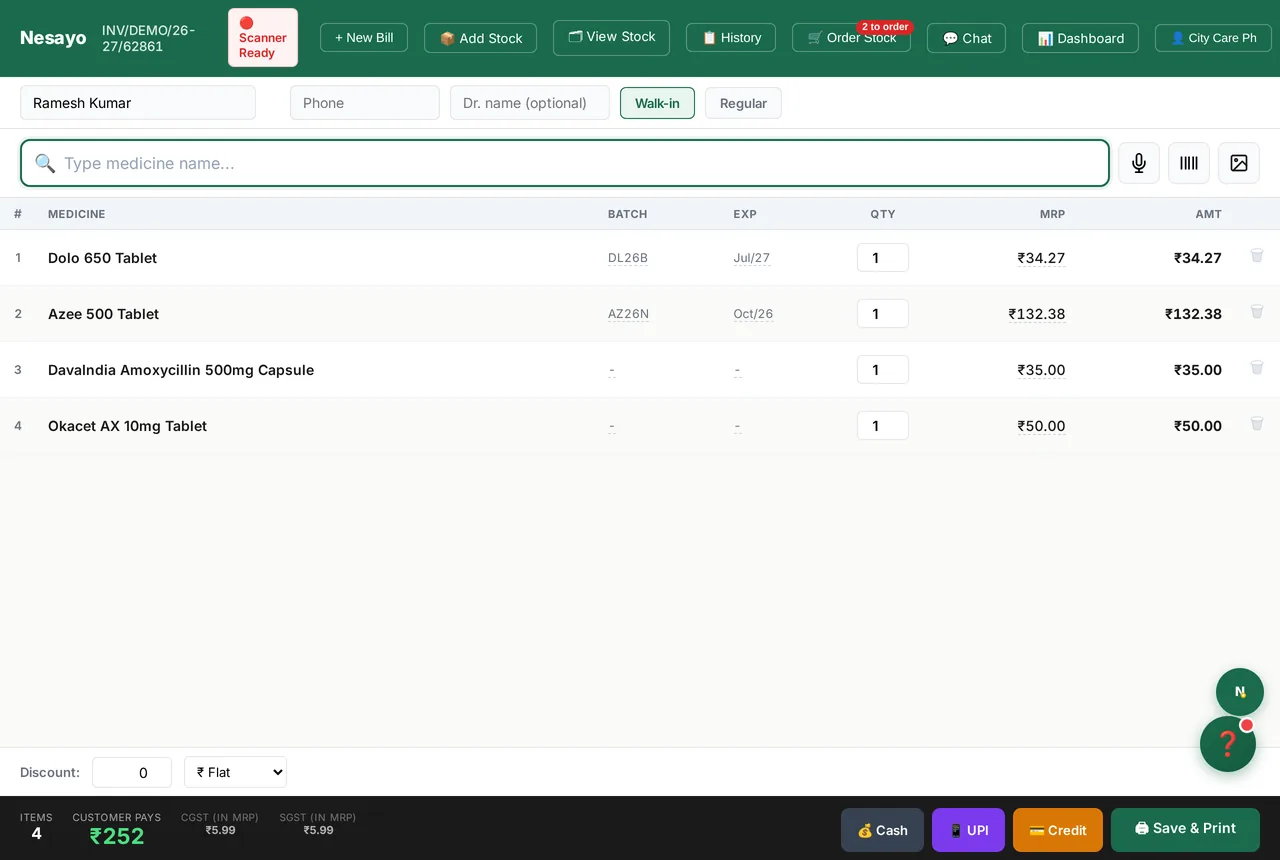
Whether the signboard says chemist, medical store or pharmacy, a bill still has to get the GST breakup, the batch and the Schedule H1 flag right — every single time, not just when someone remembers.
Last reviewed 2026-10-14
The sign outside might say Chemist, Medical Store or Pharmacy — in everyday Indian usage these words are used almost interchangeably, and the compliance the shop owes is identical whichever one is painted on the shutter. A chemist's bill has to carry a correct GST breakup for the specific medicine sold, a batch number that ties back to the exact pack taken off the shelf, and — when the medicine is Schedule H1 — a flag that the person at the counter cannot miss and a register entry filled at the time of sale, not reconstructed later from memory.
Billing software built for every kind of shop gets the invoice number and the total right. A chemist shop also needs the parts after that: the HSN code, the tax split, the batch, and the prescription-drug rules a general billing app may not know about.
This page covers what a compliant chemist bill has to show, how Schedule H1 is meant to be flagged, what voice billing looks like at a counter with both hands full, and what it costs.
In everyday Indian usage, chemist, medical store and pharmacy mostly describe the same shop. "Chemist" reflects Commonwealth/British English — in the UK, a pharmacy is a chemist's — and it is the word in the name of the country's largest trade body, the All India Organisation of Chemists and Druggists (AIOCD), which states on its own website that it represents 12.4 lakh chemists, pharmacists and distributors nationwide. "Medical store" is the more colloquial term, heard more often outside the metros. "Pharmacy" leans formal or urban. None of it is a strict rulebook — it's regional habit and shop signage.
A narrower, licence-linked distinction does exist: under the Drugs and Cosmetics framework, the shop-front name a retailer may display is tied to what the outlet actually maintains — a bare "Drug Store" licence does not require a Registered Pharmacist on staff, while "Pharmacy" or "Dispensing Chemist" is meant for an outlet that both employs a Registered Pharmacist and maintains compounding facilities. In practice this shows up in state Pharmacy Practice Regulations far more than at the counter, where the three words get used loosely by owners and customers alike — worth checking your own state's rules if you're making a signage decision rather than just a billing one.
None of that changes what the bill has to do. Whatever the signboard says, a sale is a sale under GST law and a Schedule H1 supply is a Schedule H1 supply under the Drugs and Cosmetics Rules — the obligations below apply to a chemist exactly as they apply to a pharmacy.
A chemist's bill is quietly satisfying two separate sets of rules at once — GST invoicing rules, and Drugs and Cosmetics recordkeeping rules — and missing either one shows up differently: a wrong GST filing, or a register that doesn't hold up at inspection.
The GST half (Rule 46, CGST Rules 2017). Every tax invoice needs the seller's name, address and GSTIN; a consecutive serial number; the date of issue; the buyer's details; the HSN code; a description of the medicine; the quantity; the taxable value; the GST rate; and the tax amount broken out separately as CGST, SGST/UTGST and IGST — all three columns are expected to appear even where one of them is zero. An e-invoice also carries a QR code, and a signature is not compulsory once e-invoicing applies.
How many HSN digits depends on turnover — per a CBIC notification effective 1 April 2021, a shop with turnover up to ₹5 crore in the previous financial year needs at least a 4-digit HSN code on B2B invoices (optional on B2C bills), and a shop above ₹5 crore needs a full 6-digit HSN code on every invoice, B2B and B2C alike.
The rate itself is mostly settled: following the GST Council's rate revision, most medicines have carried a flat 5% rate since 22 September 2025 (down from 12%), with a short list of life-saving drugs at nil. The rate belongs to the specific product's HSN heading, not to "medicines" as one blanket category, so it's worth checking the actual line rather than assuming.
The D&C half (Rule 65(3)). A supply made on prescription also has to be recorded — in a prescription register or on a serially numbered cash or credit memo — with the serial number, the date of supply, the prescriber's and patient's names and addresses, the drug and quantity, and, for a Schedule C, H or H1 drug, the manufacturer, the batch number and the expiry date, signed by the registered pharmacist who supplied it (Rule 65(3)(1)). A batch number on a bill is this rule speaking, not a GST requirement — which is exactly why a plain retail billing app that has never heard of Rule 65 won't print one by default.
Schedule H1 was added to the Drugs and Cosmetics Rules by the Fourth Amendment Rules of 2013, specifically to curb over-the-counter sale of habit-forming medicines and drugs that drive antimicrobial resistance. Commonly cited examples include third-generation antibiotics such as cefixime and ceftriaxone, newer fluoroquinolones such as levofloxacin and moxifloxacin, and certain psychotropic and anti-TB drugs — an illustrative list, not the complete one. The authoritative list is the notification itself, so it's worth checking a specific brand rather than assuming from the molecule name.
A Schedule H1 pack is required to carry the Rx symbol in red at the top-left corner, plus a red-bordered warning box stating that the drug is dangerous to take without a doctor's guidance and cannot be sold at retail without a Registered Medical Practitioner's prescription. At the counter, that's the fastest visual check — and exactly the check a busy evening makes easiest to skip.
The law backs that up with a paper trail: under Rule 65(3)(h), every Schedule H1 supply has to be recorded at the time of sale in a separate register, giving the prescriber's name and address, the patient's name, the drug's name and the quantity supplied — kept three years and open to inspection. "At the time of sale" is the operative phrase; an entry written from memory after closing is where gaps appear.
Why the flag has to be automatic rather than left to memory: a simulated-patient study across 200 community pharmacies in and around Guntur, Andhra Pradesh (fieldwork in 2018, published in the Indian Journal of Pharmacology in 2020) found antibiotics — several of them Schedule H1 medicines — dispensed without a prescription in 78% of visits, with only 22% of pharmacists refusing the non-prescription sale. That isn't a claim about any one shop; it's the documented size of the gap between the rule and the counter, which is what flagging Schedule H1 automatically at billing — rather than relying on memory at the till — is meant to close. More on the Schedule H1 register →
Picture a pharmacist mid-evening: one hand wrapping a strip for the customer at the window, the phone ringing, three more people waiting, and the next customer already saying the next medicine. That's the moment typing a name letter by letter costs the most — and it's the moment voice billing is built for.
Say the medicine name and the quantity — in Hindi, English or a mix of both — and it goes onto a draft bill rather than a live one. Nothing is billed and no stock moves until the draft is confirmed, the same rule that applies to every other way of adding a medicine: typed, scanned or spoken.
Voice billing isn't on the free tier. It's part of Essential, ₹249/month as of October 2026, capped at 30 voice bills a day and marked Beta, and part of the Full plan, ₹549/month as of October 2026, at 60 voice bills a day. Every new pharmacy starts with Full free for 1 month, so the first month costs nothing either way.
A busy counter is also where photographing a purchase invoice to bring stock in, or photographing a prescription to draft a bill from it, earns its keep for the same reason — hands are full and the queue doesn't pause for data entry. Photo prescription scanning shares the same Essential and Full gating as voice billing; photographing a purchase invoice to bring stock in is part of the same paid plans (and free during the first month of Full).
Billing itself — GST invoicing, batch tracking, expired-stock blocking and Schedule H1 sale logging — is free forever, no card and no time limit. The paid plans add voice billing, photo prescription scanning and the autonomous agents.
| Plan | Price | What it adds |
|---|---|---|
| Free | ₹0/month, forever, no card | Unlimited GST billing, batch-wise stock with FEFO, expired-stock blocking, Schedule H1 sale logging, GSTR-1/3B summaries (JSON and CSV) for your CA, and more than 2.5 lakh medicines in the catalogue |
| Essential | ₹249/month, or ₹2,490/year | Everything in Free, plus voice billing (30 bills/day, Beta), photo prescription scanning and patient reminders, for up to 2 users |
| Full | ₹549/month, or ₹5,490/year | Everything in Free, plus voice billing (60 bills/day, Beta), photo prescription scanning, all five AI agents, and a Tally export (XML and CSV) |
| Chain | ₹2,999/month + ₹999 per extra pharmacy | Everything in Full, across multiple stores, with one owner console and chain-wide GST rollup — invitation-only as of October 2026 |
In everyday Indian usage, none — the three words describe the same kind of shop, with "chemist" reflecting Commonwealth English usage (as in the AIOCD, the All India Organisation of Chemists and Druggists, which states it represents 12.4 lakh chemists, pharmacists and distributors on its own website) and "medical store" the more colloquial term outside metros. A narrower, licence-linked distinction exists in some states' Pharmacy Practice Regulations around whether a Registered Pharmacist and compounding facilities are maintained, but it rarely shows up at the shop signboard. Billing compliance is identical either way.
Billing is free forever on Nesayo — no card, no time limit, no bill cap — because GST invoicing, batch tracking and Schedule H1 sale logging are compliance requirements, not features to charge for. Paid plans, from ₹249/month as of October 2026, add voice billing, photo prescription scanning and the autonomous AI agents; new pharmacies get Full free for their first 1 month.
The breakup, always — CGST, SGST/UTGST and IGST shown as separate columns even where one is zero, per Rule 46 of the CGST Rules, along with the HSN code, a consecutive serial number and the medicine's GST rate. A total with no breakup isn't a compliant tax invoice.
Per a CBIC notification effective 1 April 2021, it depends on turnover: at least a 4-digit HSN code on B2B invoices if your turnover was up to ₹5 crore in the previous year (optional on B2C), and a 6-digit HSN code on every invoice, B2B and B2C, above ₹5 crore. Nesayo attaches the HSN code to the medicine automatically rather than asking you to look it up.
It's flagged the moment it goes on the bill, and the sale is logged at billing with the patient and prescriber names entered on the bill — the particulars Rule 65(3)(h) requires in the separate H1 register, recorded at the time of sale and maintained for three years. In chat, an H1 bill is not saved without both names; at the counter the doctor's name box is optional, so fill it for every H1 sale. Nesayo does not record the prescriber's address yet, so the pharmacist adds it. On the pack itself, look for the red Rx symbol at the top-left corner and the red-bordered warning box; Nesayo mirrors that flag on screen rather than leaving it to be remembered.
Yes — voice billing takes the medicine name and quantity in Hindi or English and puts them on a draft bill you confirm before anything is billed or deducted. It's on the Essential (₹249/month) and Full (₹549/month) plans as of October 2026, not the free tier, capped at 30 and 60 voice bills a day respectively and marked Beta.
Most medicines have carried a flat 5% rate since 22 September 2025, following the GST Council's rate revision (down from 12%), with a short list of life-saving drugs at nil. The rate is set per the medicine's specific HSN heading rather than one blanket "medicines" rate, so it's worth checking the exact product rather than assuming.
CSV, Excel and pipe-delimited exports are read directly, including exports from the desktop billing systems many chemist shops already run. After any import — with any vendor's software, not only ours — it's worth checking that batch numbers, expiry months and pack sizes came through correctly.
Nesayo refuses to bill a batch once its expiry month has passed — on the till, in chat and by voice — and a pack printed EXP 08/2026 stays sellable through 31 August 2026. It is a refusal rather than a warning, because selling expired stock is an offence under Section 27 of the Drugs and Cosmetics Act, not a setting a shop can turn off.
GST breakup, batch tracking and Schedule H1 flagging are all in the free tier. No card, no time limit.
Start free →