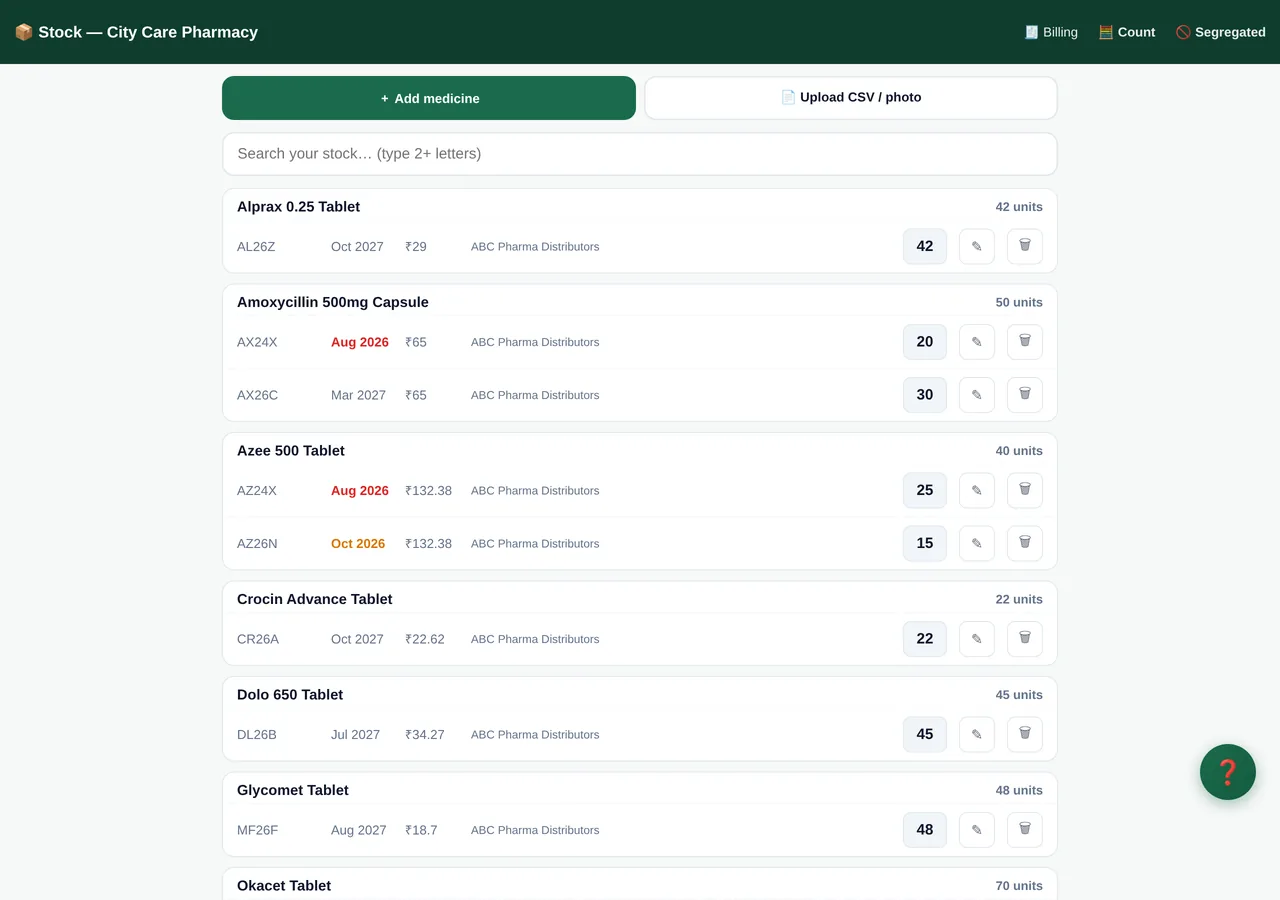
"Inventory software" for a pharmacy means something narrower than it does for any other shop: it has to think in batches, not items, because the law and the money both live at batch level.
Last reviewed 2026-10-14
Search "pharmacy inventory software" and most of what comes back is general retail stock software with a medicine name bolted on. That is a problem, because a pharmacy's stock has properties a hardware shop's does not — every unit carries its own batch number and its own expiry date, two medicines with the same name can be legally different drugs (a tablet and an injection), and some of what is on the shelf is tracked because the law says it must be, not because it is convenient.
India has no single official count of retail pharmacies, but AIOCD (All India Organisation of Chemists and Druggists) describes itself on its own site as representing over 12.4 lakh chemists, pharmacists and distributors — which gives a sense of the scale of shops running some version of this problem, on paper registers, on desktop software built for a different era, or not at all.
This page covers what actually distinguishes real pharmacy inventory software: batch-wise stock instead of item totals, FEFO instead of FIFO, a reorder level that means something instead of a number nobody trusts, and the return window that decides whether expiry is a manageable cost or a straight loss.
Most "stock management" software, pharmacy-branded or not, keeps one number per product: how many units of Paracetamol 650mg you have. That number is an item-level total, and for a pharmacy it is not enough to run the shop on, because it cannot answer the two questions that actually matter — which of those units expires first, and which purchase invoice they came from.
Batch-wise stock stores every receipt as its own row: batch number, expiry date, quantity, purchase rate and the distributor it arrived from. The item total becomes a sum of batches rather than the only thing recorded. That is what makes an accurate expiry report possible, what makes a return-to-distributor claim have the right batch number on it, and what makes a recall actionable instead of a guess.
This is not just good practice — the record-keeping rules assume it. Under Rule 65(3)(1)(f) of the Drugs and Cosmetics Rules, 1945, the sale record for a drug in Schedule C, H or H1 must additionally give the manufacturer's name, the batch number, and the date of expiry of potency. Rule 65(4)(4) requires the same at the purchase end — every purchase record must show the batch number and manufacturer, not just a quantity. An item-wise total physically cannot produce either record. Software that only tracks totals is not a lighter version of pharmacy inventory software; it is missing the part the law is checking for.
FEFO — First Expiry, First Out — dispenses whichever batch expires soonest, regardless of when it arrived on the shelf. FIFO — First In, First Out — dispenses whichever batch arrived earliest, regardless of its expiry date. In most retail categories the two amount to the same thing, because stock generally arrives in the order it will expire. In pharmacy they routinely do not: a delivery that lands today can carry a shorter dating than a pack that has been sitting on the shelf for two months, because manufacturing dates and supply timing don't move together.
Picture a pharmacist restocking a fast-moving antibiotic. The new carton from the distributor has four months left on it; the half-strip still on the shelf from three weeks ago has seven months left. Sell in arrival order (FIFO) and the short-dated carton sits underneath the long-dated one until it is too late to return. Sell by nearest expiry (FEFO) and it clears first, while it is still someone's medicine and still within the distributor's return window if it doesn't.
The only honest test of whether software actually implements FEFO is what happens at the counter: is the batch chosen automatically by expiry, or does the person billing pick from a list? A dropdown of batches is not FEFO — it is FIFO with an extra tap, because under pressure at a counter, people take the first row. See our glossary entry on FEFO for the short version.
A reorder level (or reorder point) is the stock quantity at which you should place a fresh purchase order, set so the new stock arrives before the old runs out. The standard formula is:
Reorder Level = (Average Daily Usage × Lead Time in Days) + Safety Stock
Average daily usage is how many units of that exact medicine you typically sell in a day. Lead time is how long your distributor takes to deliver once you order. Safety stock is a buffer against a slower delivery or a busier-than-usual week. All three inputs need real sales history to be meaningful — this is the part inventory tools tend to skip.
Here is the trap: a flat rule like "alert me when stock falls below 10 units" looks like a reorder level but isn't one, and it fails in both directions. For a fast-moving medicine selling four strips a day, 10 units left is barely two and a half days of cover — the alert fires too late. For a slow mover selling one strip a month, 10 units is ten months of cover; a "low stock" badge on it is not just unhelpful, it points a pharmacist toward reordering the one item that is actually at the highest risk of expiring unsold, not restocking. The unit itself can also be ambiguous — "10" might mean 10 tablets, 10 strips, or 10 bottles, depending on how the pack size was recorded, so a bare count can be misread before the demand question is even asked.
The honest position is: a reorder level is only as good as the sales history behind it. A shop with a few weeks of real billing data can size one properly. A shop with none cannot, and software that invents a confident number anyway is guessing on your behalf. Our own reorder level glossary entry and the free margin calculator are useful alongside this once you have a few weeks of billing to work from.
If your inventory software is still valuing stock against a 12% GST slab on branded medicines, it is now wrong. Before the reform, HSN 3004 medicines were split across slabs — WHO/NLEM-listed essential formulations at 5%, most branded and OTC formulations at 12%. At its 56th meeting (3 September 2025), the GST Council recommended cutting GST on "all other drugs and medicines" from 12% to 5%, effective 22 September 2025 — moving the great majority of pharmacy stock onto a single 5% slab in place of that older split. The same reform took GST to nil on 33 specified lifesaving drugs, and from 5% to nil on 3 lifesaving drugs used for cancer and other severe chronic conditions.
For inventory software this isn't just a tax-filing detail — GST is part of how landed cost and margin get calculated on every batch you receive, and it changes your GSTR-1/3B input credit workings too. Any stock valuation, margin report or purchase-cost calculation still assuming the pre-reform split is quietly overstating tax on most of what's on your shelf as of this writing (September 2026). It's also a reminder that HSN and GST on medicines are not something worth maintaining by hand per product — they belong in a table that gets updated once and applies everywhere, not retyped on every purchase entry.
The printed expiry date tells you when a medicine legally stops being sellable. It does not tell you your actual deadline, which is your distributor's return-acceptance window — commonly some months before expiry, after which the pack becomes your loss rather than theirs. That window is set by commercial terms with each distributor and varies by company, so there is no single number to quote; check your own purchase terms.
There is one statutory boundary worth knowing alongside the commercial one: under Section 34 of the CGST Act, 2017 (as amended by the Finance Act 2022), a credit note issued for a sales return — including an expired-stock return to a distributor — must be declared in the GST return by 30 November following the end of the financial year in which the original sale happened, or the date of filing the annual return, whichever is earlier. That is the outer limit on when a return can still be tax-adjusted; your distributor's own commercial window will usually close well before it.
Because the deadline that matters isn't a single date, a useful expiry view has to work in bands rather than one alert: stock 90 days from expiry is still returnable almost everywhere and worth acting on now; at 60 days the paperwork needs to already be moving; by 30 days most distributor terms have closed and it becomes a pricing or placement decision rather than a return; past expiry it comes off the shelf entirely — selling it is prohibited, and Section 27 of the Drugs and Cosmetics Act, 1940 makes stocking or selling a drug that is adulterated or spurious in a way likely to cause harm a serious offence, with contraventions of the Act's other provisions (including sale of expired stock) carrying imprisonment and a fine in their own right. See our expiry returns glossary entry for the mechanics of raising a claim.
Underneath all of this is a paper (or digital) obligation: Rule 65(7) of the Drugs and Cosmetics Rules requires pharmacy records to be preserved for not less than two years from the last entry, and Rule 65(3)(h) sets a longer bar for Schedule H1 drugs — sale must be recorded in a separate register at the time of supply, giving the prescriber's name and address, the patient's name, the drug name and the quantity supplied, kept for three years and open to inspection. For Schedule X drugs, Rule 65(9)(a) also requires the prescription itself to be retained. None of these clocks run from when you set up software — they run from the date of the entry itself, which is why a register you can search and export beats one you're hoping never gets asked for.
In practice this means a compliant stock register needs, at minimum: medicine name, batch number, expiry date, manufacturer, quantity in and out, purchase and sale dates, and — for H1 items — the prescriber and patient detail on a register the software keeps separately rather than folded into ordinary stock movement. Building that column-by-column by hand is exactly the kind of thing worth not doing manually, and it's also where a lot of registers quietly go wrong — a column left blank because nobody had the batch number to hand at the time. We publish a free, ready-to-use pharmacy stock register format with the right columns already laid out, useful whether or not you end up using software for the rest of it.
Billing, batch tracking, FEFO, expiry blocking and Schedule H1 sale logging are part of the free tier — they're compliance, not an upsell, and the free plan has no card requirement and no time limit. The AI agents — Expiry Guard, Refill Radar, Payment Advisor, Stock Sense and Morning Briefing — come with the Full plan at ₹549/month as of October 2026 (the ₹249/month Essential plan adds voice billing, prescription scanning and Refill Radar, not the full five-agent suite); new pharmacies get the Full plan free for their first 1 month, with no card; after that, the Free plan is manual billing and manual stock, with no AI features.
Item-wise software stores one running total per medicine. Batch-wise software stores every receipt separately — its own batch number, expiry date, quantity and distributor — and the item total becomes a sum of those batches. Only batch-wise stock can support FEFO, an accurate expiry report, a return claim with the right batch on it, or a recall. Indian record-keeping rules for Schedule C, H and H1 drugs (Rule 65(3)(1)(f) and 65(4)(4) of the Drugs and Cosmetics Rules) require the batch number to be recorded on both sale and purchase, so batch-wise tracking is closer to a legal minimum than an optional upgrade.
FEFO (First Expiry, First Out) dispenses the batch that expires soonest, whichever order it arrived in. FIFO (First In, First Out) dispenses the batch that arrived earliest. In pharmacy these are often different batches, because a newer delivery can carry a shorter expiry than stock already on the shelf. Software only implements FEFO if the batch is chosen automatically at billing — a dropdown of batches for a person to pick from is effectively FIFO.
The standard formula is (average daily usage × lead time in days) + safety stock. Average daily usage and lead time both need real sales and delivery history to mean anything — a reorder level guessed without that data is not a reorder level, it's a placeholder. A shop with a few weeks of consistent billing history can size this per medicine; a brand-new shop generally cannot yet, and software should say so rather than invent a confident number.
Because it ignores velocity and unit ambiguity. Ten units of a fast-moving medicine can be only two or three days of cover — the alert fires too late. Ten units of a slow mover can be many months of cover — it's not low stock at all, and flagging it points attention at the wrong item while missing that the real risk on a slow mover is expiry, not stock-out. The unit itself (tablets vs strips vs bottles) can also be unclear without a properly recorded pack size.
There's no single statutory number — it's set by your commercial terms with each distributor and typically closes some months before the printed expiry date. The one fixed legal boundary is on the tax side: under Section 34 of the CGST Act (as amended 2022), a credit note for a return must be declared in a GST return by 30 November following the financial year of the original sale, or the annual return date, whichever comes first. Your distributor's own window will usually close well before that.
At minimum: medicine name, batch number, manufacturer, expiry date, and purchase/sale quantities, retained for at least two years (Rule 65(7), Drugs and Cosmetics Rules). Schedule H1 sales additionally require a separate register recording the prescriber's name and address, the patient's name, the drug and the quantity, retained for three years (Rule 65(3)(h)). For Schedule X drugs, Rule 65(9)(a) also requires the prescription itself to be retained.
Yes. Effective 22 September 2025, the 56th GST Council meeting cut GST on most drugs and medicines from 12% to 5%, moving the majority of pharmacy stock onto a single 5% slab instead of the older 5%/12% split, alongside a nil rate on 33 specified lifesaving drugs and a cut from 5% to nil on 3 others. Any inventory or margin calculation still assuming a flat 12%, or the pre-reform split, is out of date.
It can, provided it records supply in a genuinely separate register with the prescriber and patient detail Rule 65(3)(h) requires, at the time of supply — not bolted on afterward from the same row as an ordinary sale. Worth checking specifically: does the software refuse to complete an H1 sale without that detail, or does it let the sale go through and the register go incomplete? Our own answer: a bill made in Nesayo's chat is not saved without the patient's and prescriber's names, but at the counter the doctor's name box is optional, and Nesayo does not record the prescriber's address yet — so the pharmacist completes those by hand.
It depends on the plan and provider. On Nesayo, unlimited billing with batch-wise stock, FEFO, expiry blocking, GST and WhatsApp bills is free forever with no card required. The AI agents that go looking for expiry, reorder and collection issues on their own come with the Full plan at ₹549/month as of October 2026; new pharmacies get the Full plan free for their first 1 month, with no card; after that, the Free plan is manual billing and manual stock, with no AI features.
Columns for medicine name, batch number, manufacturer, expiry date, quantity received and issued, purchase and sale dates, and — kept separately — prescriber and patient detail for Schedule H1 items. We publish a free, ready-to-use stock register format with these columns already laid out if you're maintaining one outside software.
Billing, batch tracking, FEFO and expiry blocking are free forever, no card. Two-minute signup.
Start free →