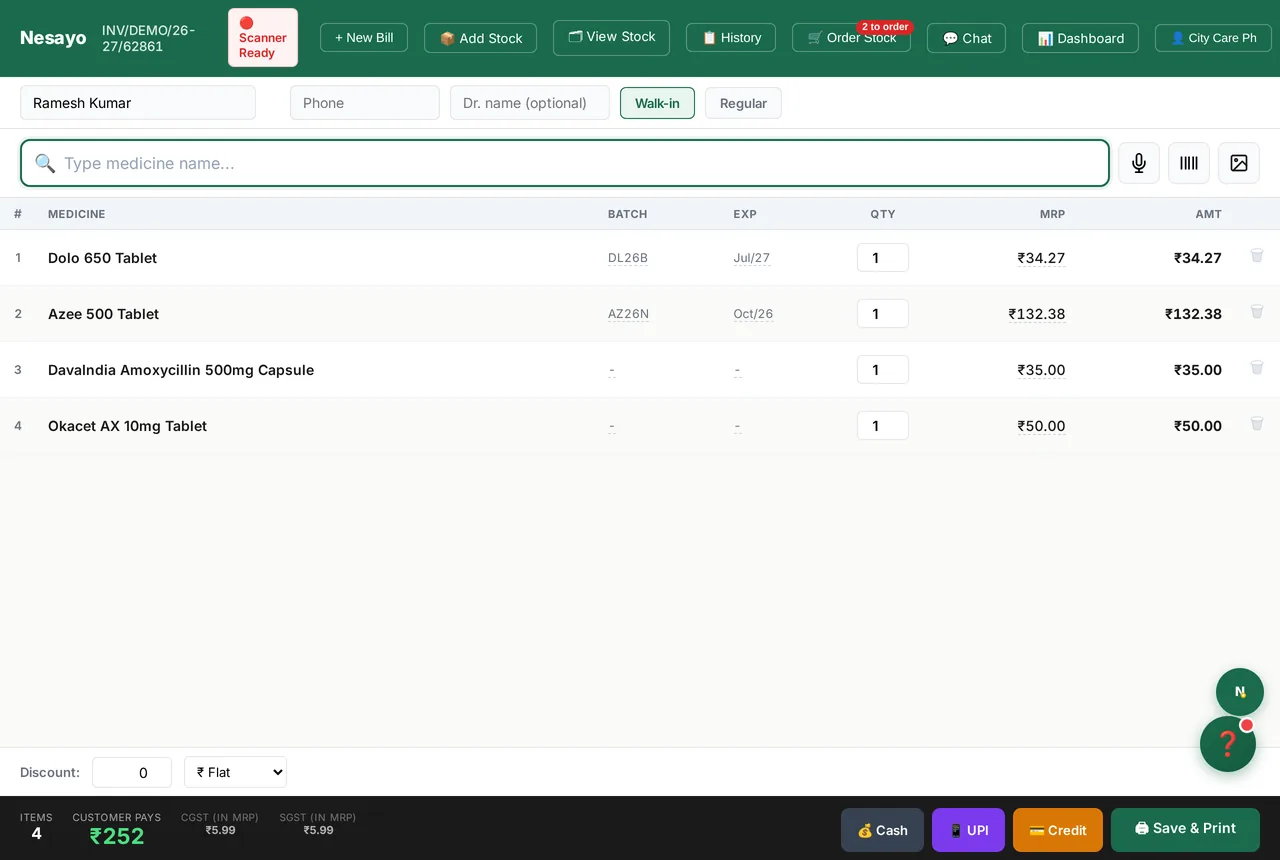
Built for the shop still running on a paper register — a phone, no installation, and a first bill out before you've decided whether to switch for good.
Last reviewed 2026-10-14
Search "medical shop software india" and most of what comes back assumes you already run one. This page is for the shop that does not — the counter where sales still go into a register by hand, where GST gets reconciled at month end from memory and carbon copies, and where "software" has so far meant a WhatsApp group and a calculator.
That is not a small or unusual position to search from. Local, unorganised medical stores accounted for roughly 88.7% of India's retail pharmacy market by value in 2021 (Netscribes India pharmacy retail market research, published November 2022), and trade bodies such as AIOCD have long put the number of retail chemists across the country at around 8.5 lakh — an industry estimate, not a census figure, but either way: most of India's medical shops look like this one, not like a chain outlet with a POS terminal and an IT person on call.
What a shop like that needs from software is narrow: get a bill out fast, on the phone already in a pocket, in whatever language is actually spoken at the counter, without paying for anything until there's a reason to. This page covers those four things, and what moving off a paper register looks like in practice.
The honest test of medical shop software is not the feature list. It's whether the first sale after signup takes longer than writing the same line in a register. For a single item, it shouldn't.
Everything in that sequence — search, batch selection, GST, the WhatsApp bill — is in the free plan. There's nothing to unlock just to get a first bill out; the paid tiers add speed and automation on top of billing (voice, photo scanning, the agents), not the ability to bill in the first place.
Medicine names on a strip are printed in Roman script whatever language the shop runs in day to day, so typed search already works regardless of what's spoken out loud — "Dolo" finds Dolo whether the person typing thinks of it in Hindi, English, or neither.
Where language actually matters is voice. Nesayo's voice billing understands Hindi and Hinglish phrasing alongside English — a spoken strength like "six fifty" is read as 650, not eaten as a separate quantity, and a mixed instruction like "do strip Crocin aur ek Dolo" is parsed as two lines rather than requiring pure English. It's currently in Beta, included from the Essential plan (₹249/month as of October 2026) at up to 30 voice bills a day, or the Full plan (₹549/month as of October 2026) at up to 60 a day.
The app's own chat replies move between Hindi, Hinglish and English rather than forcing one, because at a real counter the question and the answer rarely land in the same language twice in a row.
"Free" on most software is a clock running out. Here it's a tier: billing is free forever, with no card asked for at signup and no bill count that eventually locks you out. That includes GST invoicing, the medicine catalogue, batch-wise stock with automatic FEFO, expired-stock blocking, and the WhatsApp bill link. Moving your existing data across, where you have any, is free too.
What's not in the free tier is voice billing, photo prescription scanning, and the five autonomous AI agents — those sit on Essential at ₹249/month or Full at ₹549/month, both as of October 2026. New pharmacies get the Full plan free for their first 1 month, with no card; after that, the Free plan is manual billing and manual stock, free forever, with no AI features. Annual billing on either paid plan carries a 30-day money-back guarantee.
None of this is a demo, either — real pharmacies have billed on Nesayo from a phone since April 2026.
The thing that stalls most switches isn't the software, it's the assumption that everything has to be retyped before day one — every medicine, every current balance, every open credit account. It doesn't.
The practical order is the reverse: start billing new sales in software from today. Stock doesn't need to exist in the system before you can sell against it — if a medicine isn't yet in your list, it's added the first time it's sold, and batches build up correctly as new purchase invoices come in. A shop with a digital stock list in Excel, CSV, or even a photographed purchase invoice can bring that in directly rather than retyping it; a shop with nothing but the physical shelf can simply start, and let the record build itself one purchase at a time.
The Schedule H1 register deserves a specific note, since it's the one piece of "paper" that's a legal requirement rather than a habit. Rule 65 of the Drugs and Cosmetics Rules, 1945 does not require software — a bound paper register, correctly kept, is fully compliant on its own. What software changes is when the entry gets written: at the counter, as part of billing, instead of reconstructed from memory at closing. Rule 65 requires the prescriber's name and address, the patient's name, the drug name and the quantity supplied to be recorded at the time of supply, kept for three years, and open to inspection — the register format doesn't decide that, the rule does.
Each of these is covered in more depth on its own page, linked below, if you want the detail rather than the summary.
Yes, and the distinction is real: Nesayo's billing is free forever — no card at signup, no bill limit, no expiry date on the plan. GST invoicing, batch-wise stock, expired-stock blocking and the WhatsApp bill link are all part of that free tier. What's paid is the AI layer on top — voice billing, photo prescription scanning and the autonomous agents — from ₹249/month as of October 2026.
Yes. It runs in the phone's browser and can be added to the home screen like an app — no separate install and no PC required to start. The same account works from a phone at the counter and a computer at home with nothing to sync, but neither is required for the other.
Typed search works regardless of language, since medicine names are printed in Roman script either way. For speech specifically, Nesayo's voice billing understands Hindi and Hinglish phrasing alongside English, including spoken strengths like "six fifty" for 650. Voice billing is a paid feature, currently in Beta, from the Essential plan (₹249/month as of October 2026).
You don't need to digitise the old register to start. Begin billing new sales in the software from today; stock builds up correctly as purchase invoices come in, even if it starts empty. If you already have a stock list in Excel, CSV or a photographed invoice, that can be imported directly instead of retyped. The old paper register stays valid for however far back it goes — switching forward doesn't require rewriting the past.
Yes — Rule 65 of the Drugs and Cosmetics Rules requires the register regardless of whether it's kept on paper or in software. What software changes is when the entry gets written: filled at the counter as part of billing, rather than reconstructed from memory later. A correctly kept paper register remains fully compliant on its own; software isn't a legal requirement, only a way of not losing the details of a busy evening.
Most finished pharmaceutical formulations sit at a concessional 5%, effective 22 September 2025 following the 56th GST Council meeting, down from 12% earlier. Separately, 33 life-saving drugs were moved to Nil (from 12%) and 3 more cancer and chronic-condition drugs to Nil (from 5%) at the same meeting. A shop selling general goods alongside medicines needs both rates applied correctly per product on one bill.
No. Billing works from typed search or a photographed prescription on a phone with no additional hardware. A barcode scanner speeds up billing for a shop that already has one, and a printer is useful if a customer wants paper, but the bill itself — a GST invoice with a UPI QR code — works over WhatsApp without either.
Billing stays free forever regardless. If you want voice billing and photo prescription scanning, Essential is ₹249/month (₹2,490/year) as of October 2026. For the full set of five autonomous agents plus everything in Essential, Full is ₹549/month (₹5,490/year), also as of October 2026. New pharmacies get Full free for 1 month before either price applies.
A single-owner, single-counter shop is the normal case it's built around — one phone or one PC, no IT staff. Shops running more than one location are served separately by the Chain plan, which adds cross-store stock visibility and one console across branches; as of September 2026 that tier is by request rather than instant self-serve signup.
Billing continues through an ordinary connection drop and reconciles once the connection returns. A fully offline, permanently disconnected setup is a genuinely different case — worth testing on your own connection rather than taking on faith either way.
Billing free forever, no card. Works from the phone you already have.
Start free →